MeetYourClinic Editorial Team
Medical Tourism Research · Updated Feb 2026
Quick Summary
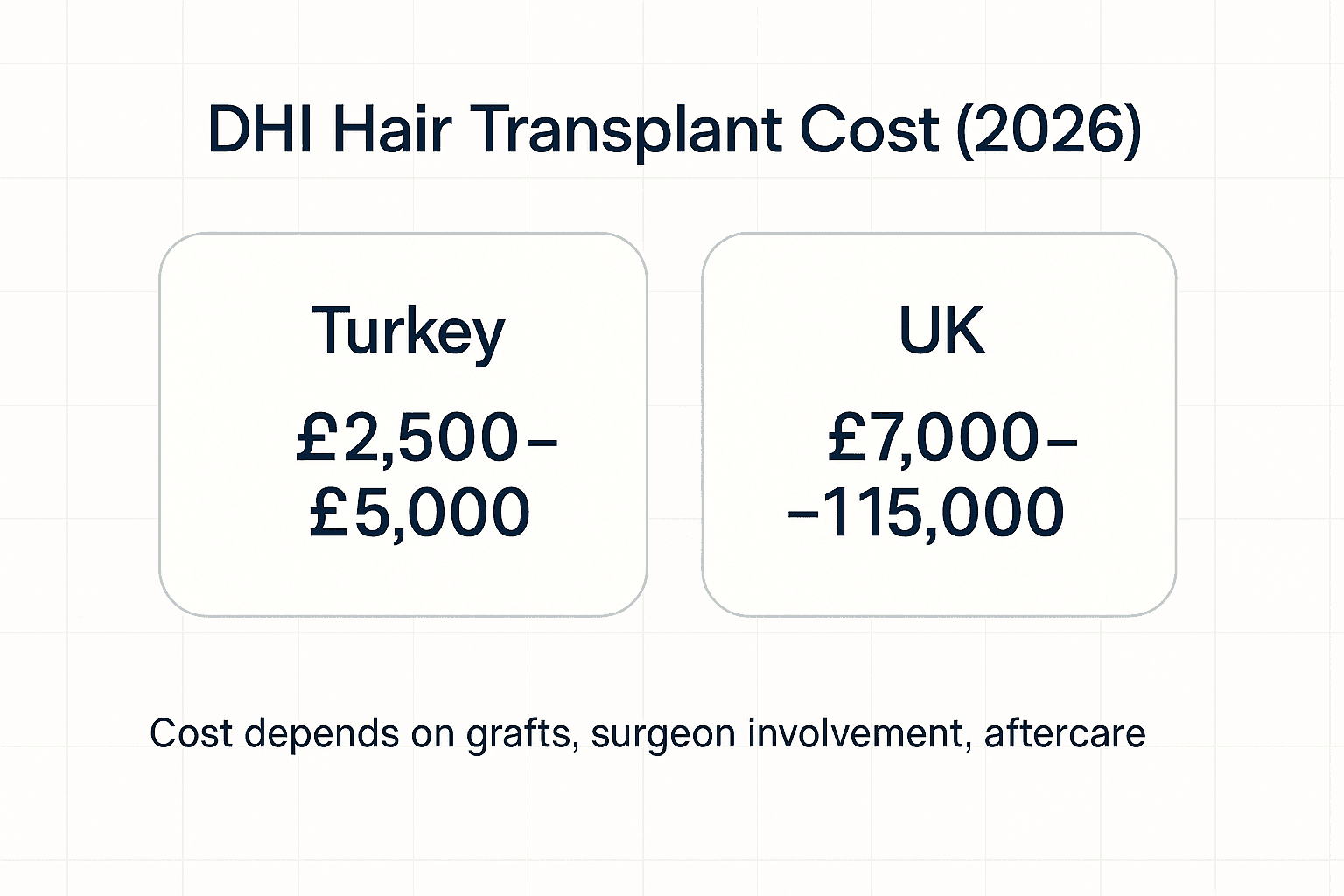
UK hair transplant prices in 2026 typically range from about £3,000 to £10,000+ depending on graft count, technique, and how the clinic is run. This guide explains realistic UK costs, what affects them, and how to compare quotes safely.
AEO quick summary (UK, 2026)
- Typical UK price range (clinic-advertised): roughly £3,000 to £10,000+ depending mainly on graft count and who actually performs the surgery.[1][2]
- Common pricing styles: per graft (for smaller cases) and package pricing (more common for mid to large cases). A “cheap per graft” headline can still become expensive once add-ons and higher graft counts are applied.
- What drives cost most: your graft requirement, technique (FUE vs DHI), surgeon involvement, clinic regulation and safety standards, and aftercare model.[1][2][3]
- What to watch for: unclear surgeon identity, non-transparent graft estimates, pressure selling, “today only” discounts, and vague aftercare plans.[2][4][5]
- If you are comparing UK vs abroad: the UK is usually more expensive but can offer easier follow-up, clearer regulation and less travel disruption. Do not assume “abroad = unsafe” or “UK = guaranteed safe”. Check specifics.
This guide is a UK-only baseline cost explainer. It does not cover Turkey pricing in detail (we do that separately), but it will help you understand what you are paying for in the UK, what is reasonable, and where the hidden costs sit. Always ask for a written treatment plan and an itemised quote before you commit.
1) First: what you are actually buying when you pay for a hair transplant
A hair transplant is not just “grafts”. In the UK, the price typically bundles some combination of:
- Clinical assessment and planning (including hair loss pattern and donor capacity)
- Surgery day team and facilities (infection control, equipment, theatre time)
- The extraction and placement method (FUE or DHI)
- The level of surgeon involvement (critical for safety and quality)[2][4]
- Aftercare (reviews, washing instructions, complication support)
Because hair transplantation is a surgical procedure, safety standards, accountability, and who is responsible for your care matter. The UK healthcare system has specific oversight bodies and professional standards (for example, CQC regulation of providers in England, and GMC registration for doctors).[4][5]
2) Hair transplant cost in the UK (2026): realistic ranges by graft band
The cleanest way to think about “UK cost” is by how many grafts you need. Every clinic estimates grafts a bit differently, so treat these bands as planning ranges, not promises.
Table: typical UK prices by graft band (FUE baseline)
| Graft band | Typical UK FUE package range (2026) | What this usually covers | Who it suits |
|---|---|---|---|
| 1,500 grafts | £3,000 to £6,000 | Smaller hairline work or early recession; limited crown work | Mild to moderate recession, refinement cases |
| 2,500 grafts | £5,000 to £8,500 | Standard “one-day” restoration for many male patterns | Hairline + mid-scalp, or moderate density build |
| 3,500 grafts | £7,000 to £11,000+ | Larger sessions, often longer theatre time and bigger team | Advanced recession, significant density build |
Why ranges are wide: surgeon time, clinic overheads, staffing model, and whether the clinic uses technicians for key steps.
Per graft pricing vs package pricing (how clinics quote)
- Per graft: Common for smaller cases. You might see £2 to £5+ per graft in the UK. The higher end can be justified where surgeon involvement is high, or the case is complex.
- Package pricing: More common for mid to large sessions. Packages can be more transparent if they clearly specify what is included (reviews, medications, aftercare) and who does what.
A good quote should tell you:
- Estimated graft count and the reason (photos, measurements, density plan)
- Whether that number is a cap or an estimate
- Whether VAT is included (it can be a surprise on cosmetic procedures)
- Who performs extraction and placement (named clinician)[2][4]
3) Technique pricing in the UK: FUE vs DHI (and what “Sapphire” really means)
Technique terms get used in marketing, but they also affect cost because they change theatre time, equipment, and team skill requirements.
Table: UK price tendencies by technique (for the same graft band)
| Technique label | What it usually means in practice | Typical UK price effect vs standard FUE | Notes |
|---|---|---|---|
| FUE | Follicular Unit Extraction (grafts removed individually, then placed into recipient sites) | Baseline | In the UK, FUE is the most common “default” technique offered |
| DHI | Often involves an implanter pen to place grafts | +£500 to +£2,000 | Can be useful for certain placement approaches, but outcomes still depend on planning and execution |
| Sapphire FUE | A sapphire blade used to create recipient incisions | +£300 to +£1,500 | This is not a separate surgery type; it is a tool choice within FUE. Do not overpay for the label alone |
If a clinic charges substantially more for a technique name, ask what specifically changes for you: graft survival measures, incision strategy, anaesthesia approach, and surgeon involvement.
4) The biggest cost driver people underestimate: who actually does the surgery
In the UK, a key quality and safety question is who is doing which parts of the procedure. Hair transplantation can involve a team, but the level of direct surgeon involvement varies.
It is reasonable to ask:
- Who extracts the grafts?
- Who designs the hairline and recipient sites?
- Who places the grafts?
- Who is responsible if there is a complication?
Professional standards and good practice guidance exist around delegation and accountability in surgery.[2][3][4]
Cost impact:
- Clinics with high surgeon involvement often cost more.
- Clinics that operate a high-volume model may quote lower, but you should verify how they maintain safety and consistency.
5) What else affects UK pricing (beyond graft count)
Case complexity
- Diffuse thinning cases can be harder to plan.
- Repair work (fixing an old transplant) often costs more.
- Crown work can be graft-hungry and less predictable.
Donor management and long-term planning
A careful plan might intentionally recommend fewer grafts now to preserve donor for the future. That can feel like you are “getting less for your money”, but it can be the right clinical decision.
Clinic location and overheads
London and large city centres often price higher due to operating costs.
Aftercare model
Some clinics offer more follow-up appointments included, while others charge per review.
Ready to Compare Clinics?
Get verified quotes from top-rated procedures clinics. Compare prices and reviews in minutes.
6) Hidden costs UK patients should budget for
Even in the UK, there are often additional costs beyond the headline surgical price:
- Consultation fees (sometimes refundable against surgery)
- Blood tests if required
- Medications and supplies: antibiotics, pain relief, saline spray, shampoo
- Time off work (many people take 3 to 7 days)
- Travel and accommodation if you are not local
- Future treatments: finasteride / topical minoxidil (if appropriate), PRP add-ons (evidence is mixed)
- VAT: ask clearly whether the price includes VAT and what makes it applicable in your case
The right way to compare quotes is to compare total expected cost for your situation, not the first number on the website.
7) What a proper UK consultation should include (and why it can change the price)
If you have had online quotes that vary wildly, it is often because the clinic has not properly assessed:
- Donor capacity (density, calibre, and safe extraction limits)
- Miniaturisation in the recipient area (which affects whether medication is sensible)
- Hairline design that matches your age and likely progression
- Whether you are a candidate at all (for example, very diffuse loss can be challenging)
A good consultation should feel like clinical planning rather than sales. BAHRS and other professional bodies emphasise careful patient selection and informed consent as part of responsible practice.[2][3]
Cost implication: a clinic that spends time on planning and sets realistic expectations may quote differently from a clinic that simply “fills a graft number”.
8) Aftercare in the UK: what is reasonable to expect (and what can cost extra)
UK aftercare can be a genuine advantage if it is structured and accessible. Ask what is included and for how long.
A typical aftercare timeline might include:
- Day 1 to 3: reassurance, swelling management, first wash guidance
- Day 7 to 14: scab care and return-to-work advice
- Month 1 to 3: shedding and “ugly duckling” phase support
- Month 6: early growth review
- Month 9 to 12: outcome review and long-term plan
Potential extras some clinics charge for:
- additional in-person reviews
- treatment for folliculitis or prolonged redness
- PRP “boost” sessions
- scar review or repair planning
If a clinic’s aftercare is vague, treat that as a pricing red flag. A clear contact route matters because even minor issues (for example, excessive swelling or signs of infection) should be triaged quickly.[1][2]
9) Regional differences inside the UK (why London often prices higher)
Within the UK, prices can differ based on operating costs and market demand:
- London / South East: often higher headline pricing
- Other major cities: sometimes mid-range
- Smaller regional clinics: can be competitive, but do not trade off due diligence
The goal is not to “find the cheapest UK city”, but to find a provider who can justify their plan and is accountable for outcomes.
10) Financing a hair transplant in the UK (what “safe” looks like)
Many UK clinics offer financing options. If you are considering it:
- Check whether the lender is FCA-regulated and whether the clinic is acting as a credit broker.
- Compare APR, total repayable, and early repayment terms.
- Be wary of pressure to finance quickly or sign before you have a full treatment plan.
Financing can make sense if it prevents you choosing a poor provider solely because it is cheaper, but do not let monthly payments distract from clinical due diligence.
11) Red flags in UK hair transplant pricing and sales behaviour
Price alone is not a red flag. The red flags are usually about opacity and pressure.
Watch for:
- No named surgeon until the day of surgery
- Unrealistic graft promises (especially for large crowns or advanced loss)
- “Unlimited grafts” packages without a careful donor assessment
- Hard selling, time-limited discounts, or deposit pressure
- No written aftercare plan, or aftercare outsourced with unclear responsibility
- No clear explanation of risks (infection, poor growth, shock loss, scarring)[1][2]
- Clinics that cannot explain their regulation status (for example, provider registration where applicable)
If you are unsure what regulation applies, the Care Quality Commission (CQC) provides information about health and social care providers in England, including whether a provider is registered and inspected.[5]
12) How to compare UK quotes properly (a simple checklist)
When you have 2 to 4 quotes, line them up and compare on the same basis:
- Graft estimate: number, method used to estimate, and density plan
- Technique: FUE vs DHI, and whether any “Sapphire” add-on is justified
- Surgeon involvement: explicit roles and accountability
- Aftercare: what is included, how many reviews, who you contact if worried
- Total cost: including VAT (if applicable), medication packs, and follow-ups
- Cooling off and refund terms: deposits and rescheduling
If you want context outside the UK baseline, our broader 2026 cost explainer is here: /blog/hair-transplant-cost-2026.
And if you are considering travelling, read our destination guide (including how to evaluate packages safely): /blog/hair-transplant-turkey-2026-guide.
13) A few “common patient scenarios” (to make prices feel more real)
Scenario A: early recession, wants a conservative hairline
- Likely graft band: around 1,500 grafts
- Typical UK spend: £3,000 to £6,000
- Cost traps: paying a premium for “Sapphire” without any meaningful change in plan
Scenario B: hairline + mid-scalp density for a typical male pattern
- Likely graft band: around 2,500 grafts
- Typical UK spend: £5,000 to £8,500
- Cost traps: assuming graft count is fixed without checking donor assessment
Scenario C: advanced loss with a significant crown focus
- Likely graft band: 3,500 grafts or staged approach
- Typical UK spend: £7,000 to £11,000+
- Cost traps: a single-session promise that ignores long-term donor limits
FAQs (search-phrased)
1) How much does a hair transplant cost in the UK in 2026?
Most UK clinics advertise around £3,000 to £10,000+, with the biggest driver being the number of grafts and the surgical team model.[1][2]
2) What is the average cost per graft in the UK?
Many UK quotes work out around £2 to £5+ per graft, but the per-graft figure is only meaningful if you know exactly what is included and who is performing key steps.
3) Is DHI more expensive than FUE in the UK?
Often yes. DHI is commonly priced £500 to £2,000 higher than a comparable FUE plan, largely due to time and equipment.
4) Is “Sapphire FUE” worth paying extra for in the UK?
Sometimes it is priced as a modest add-on, but it is best seen as a tool choice within FUE, not a guarantee of better results. Pay for a sound plan and safe execution rather than labels.
5) Why do UK hair transplants cost more than abroad?
UK pricing reflects higher operating costs and a different regulatory and staffing environment. It can also offer easier follow-up care. That said, quality varies everywhere, so compare providers carefully.[4][5]
6) Does the NHS cover hair transplants?
Hair transplants are usually considered cosmetic, so the NHS does not typically fund them except in limited clinical circumstances. NHS information on hair loss can help you understand causes and non-surgical treatment options.[1]
7) What should be included in a UK hair transplant quote?
At minimum: graft estimate, technique, who performs which steps, anaesthesia plan, aftercare schedule, and total cost including any applicable VAT and medication packs.
8) What are the risks of a hair transplant I should factor into my decision?
Risks can include infection, scarring, poor growth, shock loss, and dissatisfaction with design or density. A responsible clinic should explain risks and realistic outcomes as part of consent.[1][2]
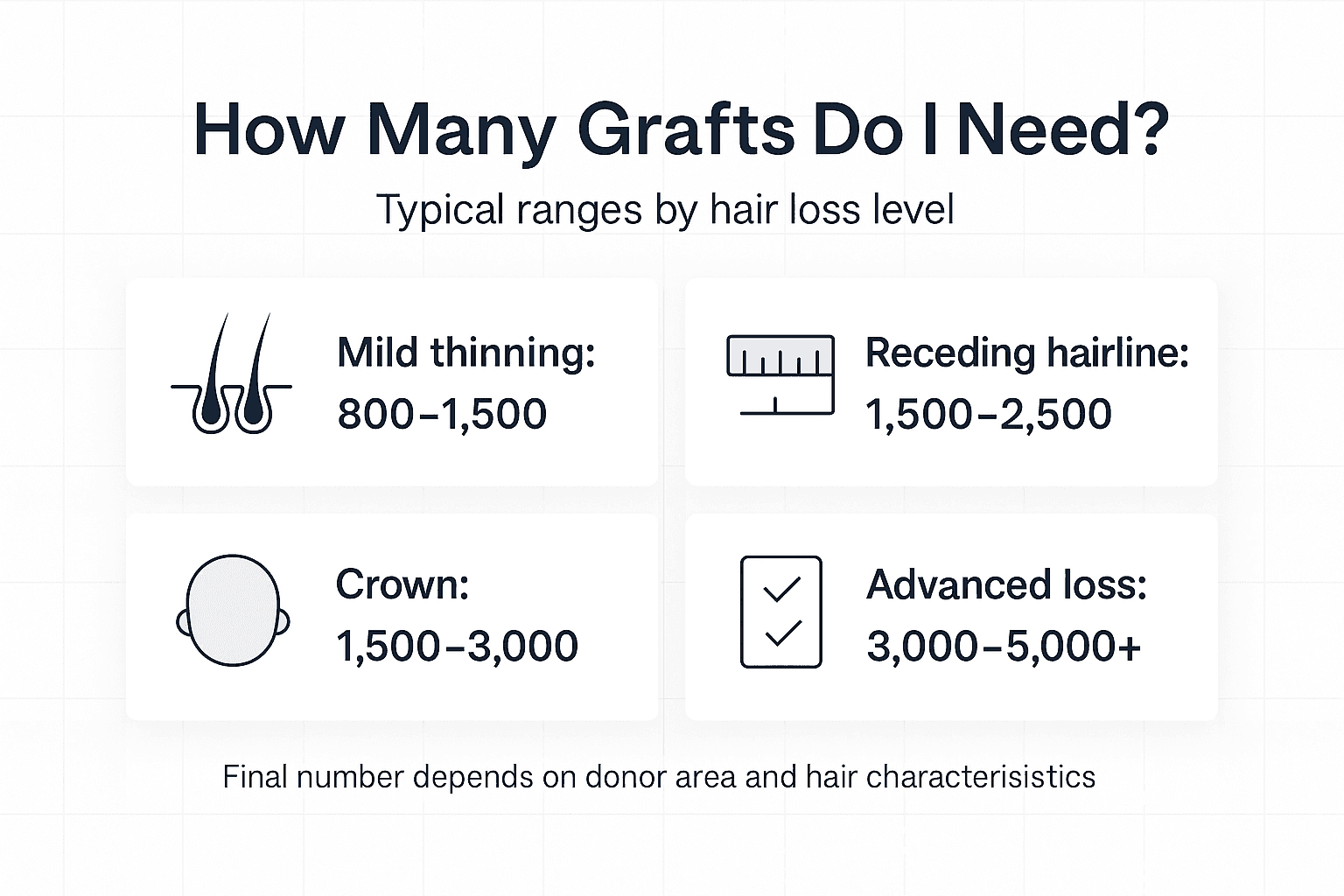
9) How many grafts do I need for a UK hair transplant?
It depends on hair loss pattern, donor density, hair characteristics, and your long-term plan. A good clinic should justify the number with photos and a density map rather than a one-line estimate.
10) How do I check a UK hair transplant clinic is legitimate?
Ask for the named doctor’s registration details (GMC if they are a doctor) and check the provider’s regulation status where applicable (for example, CQC registration in England).[4][5]
Sources
- NHS. Hair loss overview and causes (background and non-surgical context). https://www.nhs.uk/conditions/hair-loss/
- British Association of Hair Restoration Surgery (BAHRS). Patient guidance and choosing a surgeon/clinic. https://bahrssurgery.org/
- International Society of Hair Restoration Surgery (ISHRS). Patient resources and hair restoration surgery basics. https://ishrs.org/patients/
- General Medical Council (GMC). Register and professional standards for doctors (verification and accountability). https://www.gmc-uk.org/registration-and-licensing/the-medical-register
- Care Quality Commission (CQC). Find and check care services in England (provider checks). https://www.cqc.org.uk/what-we-do/services-we-regulate/find-care-services
Ready to Start Your Medical Journey?
Compare clinics, read verified reviews, and get personalised quotes from top medical facilities worldwide. Save up to 70% on your treatment.