MeetYourClinic Editorial Team
Medical Tourism Research · Updated Feb 2026
Quick Summary
Turkey performs over 550,000 hair transplants annually, capturing 38–40% of the global market. This guide covers 2026 costs ($1,500–$5,000), FUE vs DHI techniques, clinic selection criteria, real patient experiences, and everything you need to know before booking.
Turkey has cemented its position as the global capital of hair restoration. According to the Turkish Health Tourism Association, around one million people travelled to the country in 2022 for hair transplants alone, generating approximately $2 billion in revenue.[1] By 2024, Turkey’s broader medical tourism sector attracted roughly two million patients and generated close to $3 billion, according to data from the Turkish Health Ministry.[2]
The appeal is straightforward: world-class surgeons, modern facilities, and procedure costs that are a fraction of what patients would pay in the United States, United Kingdom, or Western Europe. Turkey performed approximately 550,000 hair transplant procedures in 2023, capturing an estimated 38–40% of the global medical tourism market for hair restoration.[3]
But the sheer number of clinics in Istanbul — some estimates put it at 5,000[2] — means that choosing the right one requires serious research. The International Society of Hair Restoration Surgery (ISHRS) has flagged concerns about unlicensed practitioners performing delicate procedures or rushing through multiple patients per day.[4] Not every story ends with a perfect hairline, and understanding what separates the best clinics from the rest is essential before you book.
This guide breaks down everything you need to know before booking a hair transplant in Turkey in 2026, from realistic cost expectations and technique comparisons to clinic selection criteria, real patient experiences, and post-procedure recovery.
Why Turkey Became the Hair Transplant Capital of the World
Turkey’s dominance in hair restoration did not happen by accident. Several structural factors converged over the past two decades to create an ecosystem that is difficult for other countries to replicate.
The Turkish government invested heavily in private healthcare infrastructure, resulting in JCI-accredited hospitals and specialist clinics equipped with the latest surgical technology. However, as of 2024, just 39 hospitals in Turkey hold JCI accreditation[5], and only 16 surgeons in the country are registered with the ISHRS[5] — which underscores the importance of verifying credentials independently rather than relying on marketing claims.
Istanbul’s geographic position matters too. Situated at the crossroads of Europe, Asia, and the Middle East, the city is accessible within a four-hour flight for over a billion people. Turkish Airlines operates one of the world’s largest route networks, and patients from the UK, Germany, the Gulf states, and the United States can arrive and begin consultations within the same day.
The economics are compelling. The average price per graft in Turkey is approximately $1.07, compared to $5.44 in the United States.[6] For a standard 2,500-graft FUE procedure, that translates to roughly $2,500 in Turkey versus $13,600 in the US — a 70–80% cost reduction. Even when travel and accommodation costs are factored in, most patients save 50 to 70 percent compared with domestic pricing.
How Much Does a Hair Transplant in Turkey Cost in 2026?
Pricing in Turkey is typically structured in one of two ways: per-graft pricing, where you pay a set amount for each follicular unit transplanted, or all-inclusive package pricing, which bundles the procedure with hotel accommodation, airport transfers, translation services, and aftercare products.
Average Cost by Technique
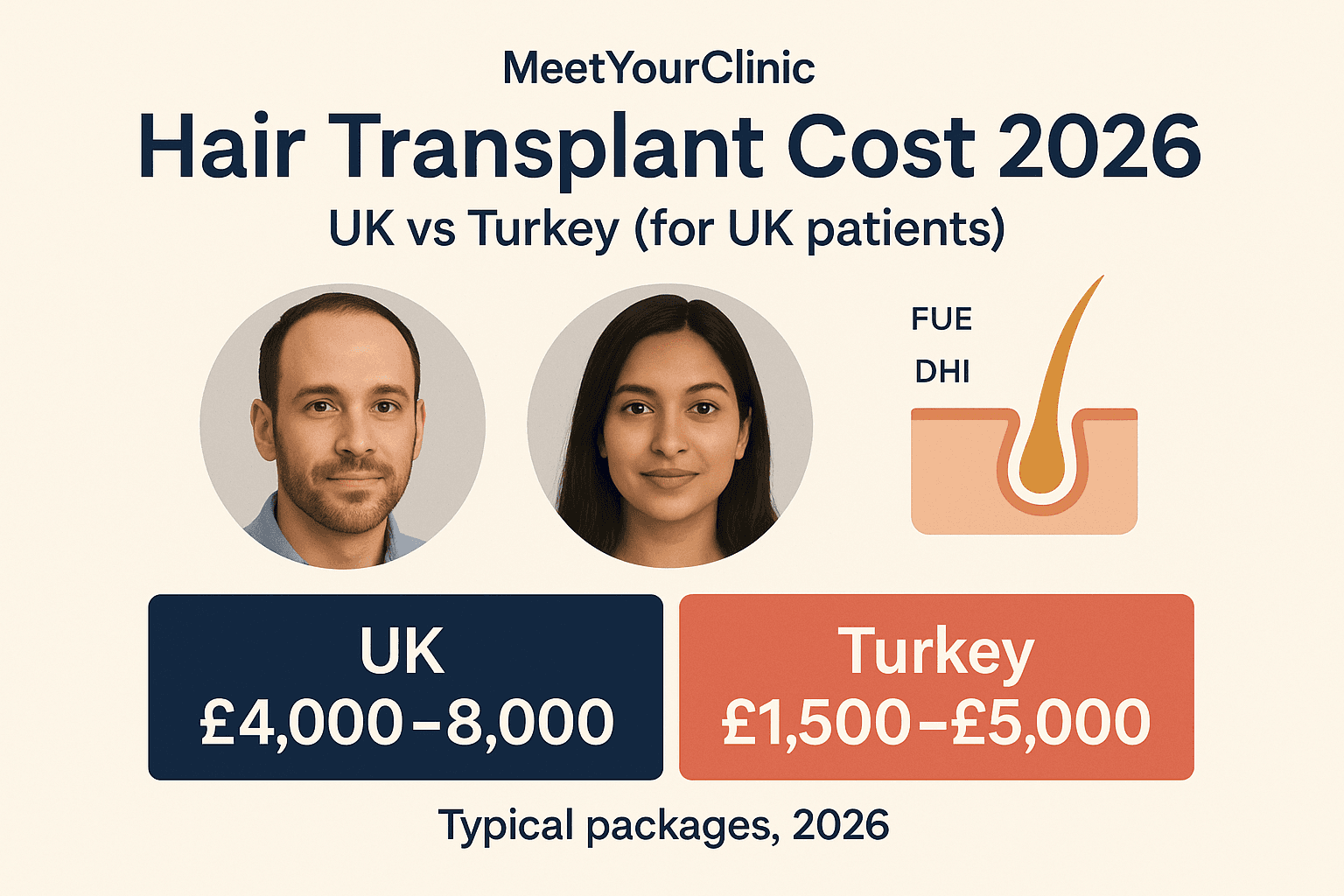
| Technique | Turkey | UK | US | Savings |
|---|---|---|---|---|
| FUE (Follicular Unit Extraction) | $1,500 – $3,500 | $5,000 – $12,000 | $8,000 – $15,000 | 60–80% |
| Sapphire FUE | $2,000 – $4,000 | $7,000 – $14,000 | $10,000 – $18,000 | 65–80% |
| DHI (Direct Hair Implantation) | $2,500 – $5,000 | $8,000 – $15,000 | $10,000 – $20,000 | 60–75% |
| Combined FUE + DHI | $3,000 – $5,500 | $10,000 – $18,000 | $12,000 – $22,000 | 65–80% |
Source: Pricing ranges compiled from ISHRS 2024 Practice Census[7], Statista Average Hair Transplant Cost Worldwide (2025)[6], and clinic surveys.
What Is Typically Included in a Turkey Hair Transplant Package
- ✓ Pre-operative blood tests and consultation with the surgeon
- ✓ The hair transplant procedure itself (including anaesthesia)
- ✓ Two to three nights of hotel accommodation (often 4–5 star)
- ✓ VIP airport transfers and transport between hotel and clinic
- ✓ Post-operative medications, shampoos, and PRP treatment
- ✓ Translation and personal patient coordinator
- ✓ Follow-up consultations via video call for 12 months
Flights are almost never included, but return flights from London or New York to Istanbul can be found for $150 to $400 depending on the season. When combined with a package, the total out-of-pocket cost for a complete hair transplant experience in Turkey typically falls between $2,500 and $6,000 — still substantially below domestic pricing in most Western countries.
FUE vs DHI: Which Technique Should You Choose?
Understanding the difference between FUE and DHI is one of the most important decisions you will make during the planning process. Both techniques are widely available across Istanbul’s top clinics, but they serve slightly different purposes and suit different types of hair loss.
FUE (Follicular Unit Extraction)
FUE is the most commonly performed technique in Turkey. Individual hair follicles are extracted from a donor area, usually the back and sides of the scalp, using a micro-punch tool. The surgeon then creates tiny incisions in the recipient area and implants each graft individually. FUE leaves no linear scar, and recovery time is relatively short. It is suitable for patients requiring a large number of grafts, often between 3,000 and 5,000 in a single session. Sapphire FUE is a refinement that uses blades tipped with sapphire crystal instead of steel, allowing for smaller, more precise incisions. A 2023 ISHRS review of 1,200 sapphire-incision cases found reduced tissue trauma and significantly faster healing compared to steel blades.[8]
DHI (Direct Hair Implantation)
DHI uses a specialised pen-like instrument called a Choi Implanter to extract and implant follicles in a single motion, without the need for pre-made incision channels. This gives the surgeon greater control over the angle, depth, and direction of each graft, which is particularly important for hairline design and achieving a natural appearance. DHI is often recommended for patients who need density work in specific areas rather than broad coverage, and it tends to be more suitable for those with moderate rather than advanced hair loss.
Which Is Better?
Neither technique is universally superior. FUE is generally better suited for patients needing a high number of grafts or coverage across a large area. DHI excels in precision work, particularly along the hairline or crown. Many of Turkey’s top clinics offer a combined approach, using DHI for the hairline and FUE for the rest of the scalp, which gives patients the best of both methods.
How to Choose a Hair Transplant Clinic in Turkey
The quality gap between clinics in Turkey is significant. A 2025 peer-reviewed study published in Aesthetic Plastic Surgery (Mayo Clinic researchers) documented concerns including aggressive digital marketing, unsupervised technicians performing procedures, bait-and-switch practices, and complication rates that burden patients’ home healthcare systems.[9] At the top end, you will find surgeon-led facilities with international accreditation and low patient-to-doctor ratios. At the lower end, some clinics process dozens of patients per day.
Here are the key factors to evaluate when comparing clinics:
Surgeon Credentials and Involvement
Verify that a board-certified surgeon performs or directly supervises the procedure. Under Turkish Ministry of Health regulations, hair transplant procedures should only be performed by licensed physicians, not technicians.[3] Ask specifically how many procedures the surgeon personally oversees each day. One to two per day is a positive sign. Five or more is a red flag. Check the ISHRS surgeon database (ishrs.org) or JCI accreditation registry to verify credentials independently.[5]
Accreditation and Facility Standards
Look for clinics operating within JCI-accredited hospitals or holding Turkish Ministry of Health certification. These facilities are subject to regular inspections covering hygiene, sterilisation, staffing ratios, and emergency protocols. Be aware that accreditation is not universal — the vast majority of Turkey’s hair transplant clinics are not JCI accredited.
Before and After Evidence
Request unedited before and after photographs, ideally at multiple post-operative stages (one month, six months, twelve months). Reputable clinics maintain comprehensive galleries showing consistent lighting and angles across timepoints. Be cautious of clinics that only show immediately post-operative results, as these can be misleading. Ask whether the clinic can connect you with previous patients for references.
Patient Reviews and Reputation
Cross-reference reviews across independent platforms like Trustpilot, Google Reviews, and Reddit communities such as r/HairTransplant and r/tressless rather than relying solely on testimonials published on the clinic’s own website. Look for patterns in reviews rather than focusing on individual comments. Consistent praise for communication, surgeon involvement, and natural-looking results is a strong indicator of quality.
Aftercare and Follow-Up
Complications can arise days or weeks after the procedure. Ensure the clinic provides a clear aftercare protocol, accessible post-operative support (ideally via WhatsApp or video call), and a named point of contact for any concerns that arise after you return home.
Ready to Compare Clinics?
Get verified quotes from top-rated procedures clinics. Compare prices and reviews in minutes.
Real Patient Experiences: What People Actually Say
One of the best ways to set realistic expectations is to hear from patients who have been through the process. We reviewed hundreds of patient testimonials across Trustpilot, Reddit, and independent review platforms to identify the consistent themes — both positive and negative — that emerge from real experiences.[10][11][12]
What Patients Consistently Praise
"Everything from communication right from the start to the present moment has been incredible. From the initial enquiry, transport, and patient experience, these people made the trip extremely smooth. The hotel was 5 star. There were 10 other guys on the same day having a procedure. The injections hurt and sting for the first few minutes until it starts to go numb. This was painful but bearable."
— Trustpilot reviewer, 3,500-graft FUE procedure, Istanbul (2025)
Across hundreds of reviews, the most frequently praised aspects of the Turkey hair transplant experience include: the seamless logistics of all-inclusive packages (airport pickup, hotel, clinic transfers), the professionalism and attentiveness of patient coordinators, the painless nature of the procedure itself after initial anaesthesia, and the responsiveness of WhatsApp-based aftercare support in the weeks following surgery.[10]
"I first reached out after discovering them through the Hair Transplant group on Reddit. Three things convinced me: all procedures led by a dermatologist surgeon, they only see one patient per day, and they use the Sapphire FUE technique. The communication was outstanding throughout."
— Trustpilot reviewer, 4,500-graft Sapphire FUE, Istanbul (2025)
Common Concerns and Realistic Expectations
Not every review is glowing. The most common criticisms across independent platforms focus on three areas: communication gaps between the pre-booking sales team and the actual clinical staff, the shock of the shedding phase at months one to three when transplanted hairs fall out (many patients describe feeling panicked despite being told this is normal), and uneven results when clinics over-promise graft counts without properly assessing donor area limitations.
"At four months I was genuinely worried. The shedding phase is real and nobody can fully prepare you for how discouraging it is. But by month eight the density was building noticeably, and at twelve months I was thrilled. Patience is everything."
— Reddit user, r/HairTransplant (2025)
The ISHRS has also documented cases where patients were promised a specific graft count during initial consultation but received fewer grafts during the actual procedure — a practice known as "bait and switch."[4] This is why it is critical to confirm graft counts in writing before the procedure begins and to ensure your surgeon reviews your specific case in person, not just via photos sent to a sales team.
Red Flags Patients Wish They Had Known
Based on negative patient experiences documented by the ISHRS Fight the FIGHT campaign[4] and corroborated by independent Trustpilot and Reddit reviews, the biggest warning signs include: clinics that quote a graft count without seeing photographs of your scalp, package prices below $1,500 (which often indicate technician-led procedures with minimal surgeon involvement), clinics that schedule five or more patients per surgeon per day, and aggressive WhatsApp sales tactics with pressure to book immediately.
One peer-reviewed study noted that clinics offering procedures below $1,500 warrant particular scrutiny, as such pricing often indicates compromised quality or safety protocols.[3]
What to Expect: A Day-by-Day Timeline
Day 1: Consultation and Planning
You arrive in Istanbul and are transferred to your hotel. Many clinics schedule a same-day consultation where the surgeon examines your scalp, discusses your expectations, takes blood tests, and draws the hairline design. This is your opportunity to ask questions and ensure you are comfortable before proceeding.
Day 2: Procedure Day
The procedure typically takes between six and ten hours, depending on the number of grafts. It is performed under local anaesthesia, so you are awake throughout. Most patients report minimal discomfort after the initial injections. For larger sessions exceeding 6,000 grafts, reputable clinics split the procedure across two days to reduce graft ischaemia time and surgeon fatigue, which has been shown to improve graft survival rates.[8]
Day 3: First Wash and Departure
The clinic performs your first post-operative wash and demonstrates the technique you will use at home for the following two weeks. You receive detailed written and video instructions. Most patients fly home on this day, though some clinics recommend staying an extra night.
Weeks 1 to 2: Initial Recovery
Swelling around the forehead and eyes is common and typically subsides within five to seven days. You will follow a specific washing routine to keep the grafted area clean without dislodging the follicles. Scabbing forms and falls away naturally over ten to fourteen days. Most patients return to desk-based work within three to five days.
Months 1 to 3: Shedding Phase
The transplanted hairs shed during this period, which is entirely normal and is experienced by virtually all patients. The follicles remain embedded in the scalp and will re-enter their growth cycle. This phase can be discouraging for patients who are unprepared for it, but it is a standard part of the process that does not indicate a problem with the transplant.
Months 4 to 8: Growth Phase
New hair begins to emerge and thicken progressively. By the six-month mark, most patients see noticeable improvement. Some clinics recommend PRP (platelet-rich plasma) injections during this phase, which 2024–2025 studies have shown may improve density and thickness when paired with surgery, though evidence remains mixed.[13]
Months 10 to 14: Final Results
Full results are typically visible between ten and fourteen months post-procedure. Follow-up data from high-volume Istanbul clinics shows that 92% of patients report satisfactory coverage by month twelve when the initial graft count was appropriate for their level of hair loss.[8] At this stage, the transplanted hair behaves like natural hair and can be cut, styled, and washed normally.
Risks and How to Minimise Them
Hair transplant surgery in Turkey is generally safe when performed by qualified professionals in accredited facilities, but it is still a medical procedure with inherent risks. The most common concerns include infection at the donor or recipient site, poor graft survival resulting in patchy or thin coverage, unnatural-looking hairlines caused by incorrect graft angle or depth, scarring in the donor area, and shock loss of existing hair surrounding the transplanted zone.
Most of these risks are directly linked to clinic quality and surgeon experience. The 2025 Mayo Clinic review highlighted that the expanded role of unsupervised technicians and high patient-to-surgeon ratios are primary contributors to complication rates in Turkish clinics.[9] Choosing an accredited clinic with a board-certified surgeon who limits their daily patient volume is the single most effective way to reduce complications.
Patients should follow aftercare instructions precisely, avoid sun exposure and strenuous exercise during recovery, and attend all scheduled follow-up appointments. It is also worth considering extending your stay by an extra day or two if you have additional risk factors such as blood clotting conditions.
Best Time of Year to Get a Hair Transplant in Turkey
The procedure can be performed year-round, but timing matters for two practical reasons. First, avoiding direct sun exposure during the first few weeks of recovery is important, which makes the peak summer months of July and August less ideal unless you are disciplined about wearing a loose hat and staying out of the sun. Second, clinic demand peaks during spring (April to June) and early autumn (September to November), which means wait times for the most sought-after surgeons can be longer during these periods.
Winter months, particularly January and February, offer shorter wait times, easier scheduling, and the practical benefit of naturally avoiding sun exposure during recovery. Many clinics also offer promotional pricing during the quieter season.
Find Your Hair Transplant Clinic in Turkey
Ready to take the next step? MeetYourClinic connects you with verified, accredited hair transplant clinics across Istanbul and Turkey. Compare prices, read patient reviews, view before-and-after galleries, and request free consultations — all in one place.
Browse hair transplant clinics in Turkey →
Sources & References
- Turkish Health Tourism Association. Hair transplant tourism data, 2022. Via NPR, “What makes this country a top destination for hair transplants” (October 2025)
- Turkish Health Ministry. Medical tourism statistics, 2024. Via NPR (October 2025).
- Turkish Health Tourism Association, 2023. As cited in BraveWords evidence-based guide (December 2025)
- International Society of Hair Restoration Surgery (ISHRS). Fight the FIGHT campaign
- Wimpole Clinic / Dr. Dinesh Patel (GMC No: 7992217). Turkish Hair Transplant Clinic Red Flags (October 2025)
- Statista. “Average Hair Transplant Cost Worldwide” (2025). Also cited by Medihair.com
- ISHRS Practice Census, 2024. Global hair restoration procedure data and cost benchmarks.
- VeraClinic, Istanbul. Clinical data including 2023 ISHRS sapphire-incision case review. veraclinic.net
- Haider SA, et al. “The Allures and the Alarms of the Hair Transplant Tourism Industry.” Aesthetic Plastic Surgery. 2025;49(17):4745–4753. PubMed
- Smile Hair Clinic — Trustpilot (3,769 reviews)
- Clinicana — Trustpilot (1,298 reviews)
- UnitedCare Clinic — Trustpilot
- Look Medic. Turkey Hair Transplant Timeline 2025
Frequently Asked Questions
Hair transplant costs in Turkey range from $1,500 to $5,000 depending on the technique, number of grafts, and clinic tier. FUE procedures typically cost between $1,500 and $3,500, while DHI procedures range from $2,500 to $5,000. Most all-inclusive packages include hotel accommodation, airport transfers, and aftercare. The average price per graft in Turkey is $1.07, compared to $5.44 in the United States (Statista, 2025).
Yes, when performed by a board-certified surgeon in an accredited facility. Turkey has a well-established medical tourism infrastructure, and its top clinics meet international standards. However, the ISHRS has flagged concerns about unlicensed practitioners at some clinics. The key is thorough research: verify the surgeon’s credentials through the ISHRS database, check independent reviews on Trustpilot and Reddit, and confirm the clinic holds JCI accreditation or Turkish Ministry of Health certification.
Graft requirements depend on the extent of hair loss, the density you want to achieve, and your donor area capacity. Patients with early-stage thinning may need 1,500 to 2,500 grafts, while those with advanced hair loss (Norwood 4 to 6) may require 4,000 to 6,000 grafts. Around 3,000 grafts is considered the sweet spot for most Norwood 3–4 patients. A qualified surgeon will assess your specific needs during the consultation.
FUE extracts individual follicles and implants them into pre-made incisions. DHI uses a Choi Implanter pen to extract and implant follicles in a single motion, offering greater precision for hairline work. FUE is better suited for high graft counts and broad coverage, while DHI excels at density and precision in targeted areas. Many leading clinics now offer a combined FUE + DHI approach.
Most clinics require a minimum stay of two to three nights. Day one is reserved for consultation and blood work, day two for the procedure, and day three for the first post-operative wash and departure briefing. Some patients choose to stay an additional day or two for recovery comfort.
Final results are visible between ten and fourteen months after the procedure. Transplanted hairs shed during months one to three, which is normal. New growth begins around month four and progressively thickens. Most patients see significant improvement by month six, with full density reached by month twelve to fourteen.
When performed by an experienced surgeon, modern hair transplant results are virtually undetectable. The key factors are correct hairline design, appropriate graft angle and direction, and natural density distribution. Turkish clinics achieve an average recipient area density of 40–50 follicular units per square centimetre (ISHRS Clinical Guidelines, 2024).
Many patients do, though it is advisable to schedule sightseeing before the procedure rather than after. Post-operatively, you should avoid direct sun exposure, swimming, and strenuous activity for at least two weeks. Istanbul offers world-class culture, cuisine, and history, making it an appealing destination beyond the medical purpose of the trip.
Ready to Start Your Medical Journey?
Compare clinics, read verified reviews, and get personalised quotes from top medical facilities worldwide. Save up to 70% on your treatment.